
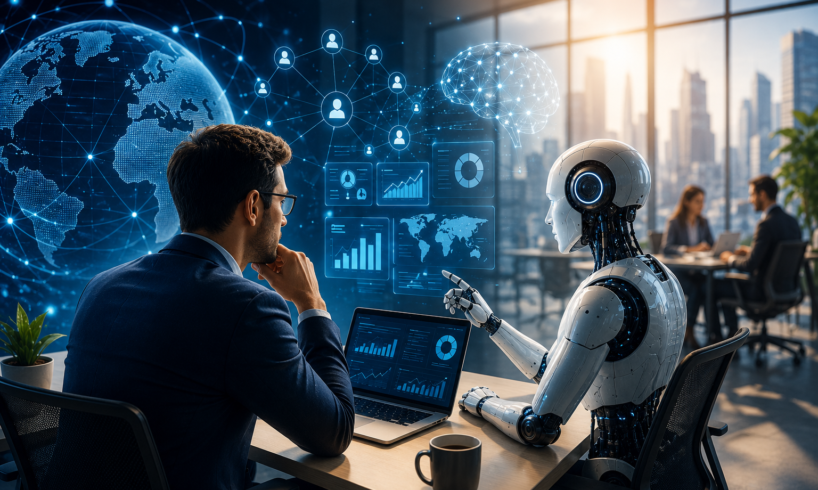
- AI and the Future of Work: Artificial Intelligence (AI) is no longer a futuristic concept, it has become a powerful force reshaping how people work, learn, and do business.
- From writing emails and creating presentations to diagnosing diseases and assisting software developers, AI is rapidly becoming part of everyday life. But one question continues to dominate conversations around the world:
AI and the Future of Work
Will AI replace our jobs?
The answer is more complex than a simple “yes” or “no.”
History shows that every major technological revolution has changed the way people work. The Industrial Revolution introduced machines that transformed manufacturing. The internet revolution changed communication, commerce, and access to information. Smartphones reshaped entire industries within a decade.
Now, Artificial Intelligence represents the next major transformation.
Unlike previous technologies, AI can perform tasks that once required human reasoning, creativity, language understanding, and decision support. This has sparked excitement about increased productivity while also raising concerns about job security.
However, experts largely agree on one important point:
AI is expected to change far more jobs than it completely eliminates.
The future workplace will likely involve collaboration between humans and intelligent machines rather than a competition where one completely replaces the other.
This article explores how AI is changing the global workforce, which industries are experiencing the biggest transformation, and what professionals, students, and businesses can do to prepare for the coming decade.
Why AI Is Different From Previous Technologies
Every major technological breakthrough has automated certain tasks, but AI stands apart because it can process language, recognize patterns, analyze enormous amounts of data, and generate new content within seconds.
Modern AI systems can:
- Write reports and emails
- Summarize lengthy documents
- Analyze financial data
- Generate computer code
- Create images and videos
- Translate between languages
- Assist doctors with medical analysis
- Help lawyers review legal documents
- Support customer service around the clock
Instead of simply replacing physical labor, AI increasingly supports knowledge-based work—something earlier technologies could not do at the same scale.
This doesn’t necessarily mean human expertise becomes less valuable. In many cases, AI handles repetitive or time-consuming tasks, allowing people to focus on strategic thinking, creativity, relationship-building, and complex decision-making.
The Numbers Behind the AI Revolution
Artificial Intelligence is expanding at a pace few technologies have matched.
Across industries, organizations are investing billions of dollars in AI research, infrastructure, and business applications. Companies are integrating AI into customer support, software development, healthcare, finance, education, manufacturing, logistics, marketing, and scientific research.
Several global trends are already visible:
- Businesses are adopting AI to improve productivity and reduce repetitive work.
- Employers increasingly seek candidates with AI literacy alongside traditional skills.
- Governments worldwide are investing in AI research and digital infrastructure.
- Universities are introducing AI-focused courses across multiple disciplines.
- Small businesses are using AI tools that were once available only to large enterprises.
Rather than affecting only the technology sector, AI is becoming a general-purpose technology that influences nearly every profession.
AI Is Already Changing the Way People Work
Many people imagine AI as something that will transform workplaces years from now. In reality, that transformation has already begun.
Consider a typical workday in different professions:
Marketing Professionals
Marketing teams use AI to generate campaign ideas, draft social media content, analyze customer behavior, optimize advertisements, and identify emerging trends. Human marketers still develop brand strategy and make creative decisions, but AI significantly speeds up execution.
Software Developers
Developers increasingly rely on AI coding assistants to suggest code, identify bugs, generate documentation, and automate repetitive programming tasks. This allows engineers to spend more time solving complex technical challenges.
Healthcare Professionals
Doctors and radiologists use AI-assisted tools to analyze medical images, organize patient records, and support diagnosis. These systems help improve efficiency while leaving final clinical decisions to trained medical professionals.
Financial Services
Banks and financial institutions use AI to detect fraud, assess risk, automate compliance checks, and improve customer service through intelligent chatbots.
Education
Teachers use AI to prepare lesson plans, personalize learning materials, create quizzes, and provide faster feedback. Students increasingly use AI for research support, language learning, and academic assistance.
In each of these examples, AI acts as a productivity partner rather than a complete replacement for human expertise.
The Biggest Misconception About AI
One of the most common misconceptions is that AI will simply “take everyone’s job.”
The reality is more nuanced.
Jobs are made up of many different tasks. AI excels at some of these tasks but struggles with others.
For example:
- An accountant spends time entering data, checking compliance, advising clients, and solving complex financial problems.
- AI may automate routine bookkeeping and document analysis.
- Human accountants remain essential for strategic advice, ethical judgment, regulatory interpretation, and client relationships.
This pattern applies across many industries.
Rather than replacing entire professions overnight, AI often automates specific tasks within those professions.
As routine work becomes increasingly automated, demand for skills such as critical thinking, communication, creativity, leadership, and problem-solving is expected to grow.
A Global Workforce in Transition
The shift toward AI-powered workplaces is not limited to one country or industry.
Technology companies, manufacturers, hospitals, universities, governments, financial institutions, media organizations, retailers, and startups are all experimenting with AI-powered workflows.
Emerging economies, including India, are also witnessing rapid AI adoption.
Indian startups are building AI products for healthcare, agriculture, education, finance, and customer service. Large IT companies are investing heavily in AI capabilities, while educational institutions are expanding AI-related training programs to prepare students for future careers.
The pace of adoption varies by industry, but one trend is becoming increasingly clear:
Workers who learn to use AI effectively are likely to have a significant advantage over those who ignore it.
Artificial Intelligence is not simply another software upgrade. It represents one of the most significant shifts in the history of modern work.
Some repetitive tasks will disappear.
Many existing roles will evolve.
Entirely new careers will emerge.
The professionals who thrive over the next decade are unlikely to be those who compete against AI. Instead, they will be those who learn how to work alongside it, combining human judgment, creativity, empathy, and expertise with the speed and efficiency of intelligent systems.
Understanding how AI is reshaping work is only the beginning. The real question is which professions are likely to experience the biggest transformation over the coming years. Let’s examine the careers where AI is expected to have the greatest impact – and the skills professionals will need to stay ahead.
25 Jobs That Will Change the Most by 2030
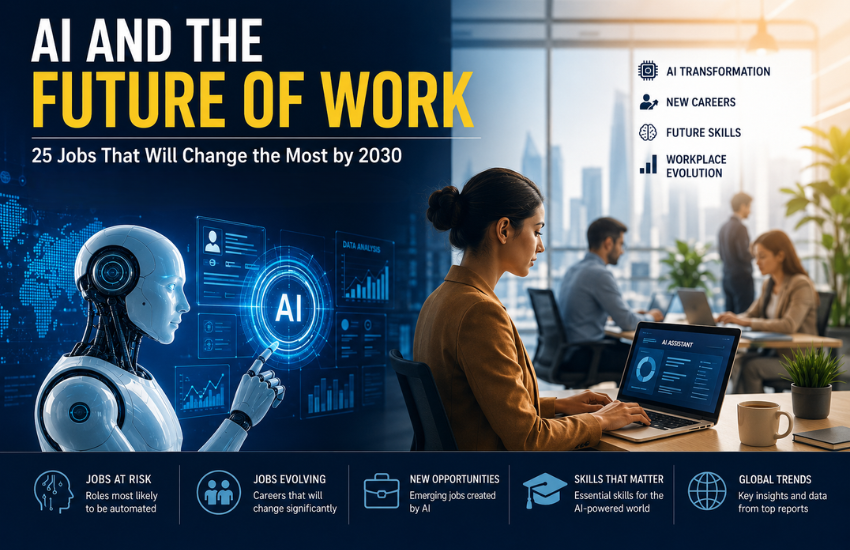
The discussion around AI and the Future of Work often focuses on a single question: Which jobs are most at risk? In reality, the better question is how these jobs are changing.
Artificial Intelligence is expected to automate repetitive, data-intensive, and predictable tasks. At the same time, it is creating demand for professionals who can combine human judgment, creativity, emotional intelligence, and technical expertise with AI-powered tools.
Below are 25 professions expected to undergo significant transformation over the next decade.
1. Customer Service Representatives
Current Role
Customer service teams answer questions, resolve complaints, process requests, and maintain customer relationships through phone, email, and chat.
How AI Is Changing This Job
Modern AI chatbots and virtual assistants can now handle thousands of routine customer queries simultaneously. They can provide instant responses, track orders, reset passwords, and answer frequently asked questions 24/7.
What AI Can Automate
- Basic customer queries
- Order tracking
- Appointment scheduling
- FAQs
- Ticket routing
Human Skills That Become More Valuable
- Conflict resolution
- Emotional intelligence
- Complex problem-solving
- Relationship management
Future Outlook: High Transformation
Key Takeaway: Customer service professionals who specialize in handling complex customer issues and building long-term relationships will remain highly valuable.
2. Software Developers
The rise of AI coding assistants has sparked concerns that programmers may become obsolete. However, AI and the Future of Work suggest a different reality.
How AI Is Changing This Job
AI can generate code, explain programming concepts, identify bugs, and automate repetitive coding tasks.
Developers increasingly spend less time writing routine code and more time designing software architecture, reviewing AI-generated output, and solving complex business problems.
What AI Can Automate
- Code generation
- Documentation
- Bug detection
- Unit testing
- Code suggestions
Skills That Matter
- System design
- Cybersecurity
- AI integration
- Problem-solving
- Product thinking
Future Outlook: Medium Transformation
Key Takeaway: AI is becoming a powerful assistant for developers—not a replacement for experienced engineers.
3. Accountants
Accounting has always involved large amounts of structured data, making it one of the professions significantly influenced by AI.
AI Workplace Transformation
Modern accounting software can automatically categorize transactions, reconcile accounts, identify anomalies, and prepare financial reports.
Tasks Likely to Be Automated
- Data entry
- Invoice processing
- Expense categorization
- Tax calculations
- Compliance checks
Human Value
Professional accountants remain essential for:
- Financial planning
- Strategic business advice
- Risk assessment
- Regulatory interpretation
- Client consultation
Future Outlook: High Transformation
4. Graphic Designers
Generative AI can create logos, illustrations, advertisements, and social media graphics within minutes.
However, businesses still rely on designers who understand branding, storytelling, user psychology, and marketing objectives.
AI Can Help With
- Background removal
- Image generation
- Design variations
- Mockups
- Color suggestions
Human Skills
- Brand strategy
- Creative direction
- Visual storytelling
- Client communication
Future Outlook: Medium Transformation
5. Content Writers and Journalists
Content creation has become one of the most discussed areas in AI and the Future of Work.
AI can draft articles, summarize documents, generate headlines, and assist with research.
Yet high-quality journalism requires:
- Fact-checking
- Original reporting
- Interviews
- Investigative research
- Editorial judgment
Readers increasingly value trustworthy, well-researched content over mass-produced text.
Future Outlook: Medium Transformation
6. Teachers and Educators
Education is rapidly embracing AI-powered learning platforms.
Teachers can now generate lesson plans, quizzes, personalized assignments, and learning recommendations within minutes.
AI Can Automate
- Administrative tasks
- Attendance analysis
- Quiz generation
- Basic tutoring
- Personalized practice
Human Strength
Students continue to benefit from teachers who inspire curiosity, provide mentorship, encourage collaboration, and understand emotional and social development.
Future Outlook: Medium Transformation
7. Doctors and Healthcare Professionals
Artificial Intelligence is helping healthcare professionals analyze medical images, monitor patients, and identify disease patterns more quickly.
AI Supports
- Medical imaging
- Patient records
- Drug discovery
- Clinical documentation
- Predictive analytics
Human Expertise Remains Essential
Medical diagnosis involves ethics, empathy, patient communication, and complex decision-making that AI cannot fully replace.
Future Outlook: Low Replacement Risk
Healthcare professionals who understand AI tools may become even more effective.
8. Lawyers
Legal professionals increasingly use AI for document review, contract analysis, and legal research.
AI Can Handle
- Contract summarization
- Legal document search
- Compliance review
- Case research
Lawyers Still Lead
Courtroom advocacy, negotiation, legal strategy, and interpreting complex laws require human judgment and accountability.
Future Outlook: Medium Transformation
9. Marketing Professionals
Marketing is becoming one of the fastest-changing careers in the era of AI and the Future of Work.
AI helps marketers analyze customer behavior, predict trends, create advertisements, and optimize campaigns.
AI Tools Assist With
- Ad copy
- Email campaigns
- Market analysis
- Customer segmentation
- Performance reporting
Human Advantage
Successful marketers still depend on creativity, brand positioning, consumer psychology, and business strategy.
Future Outlook: Medium Transformation
10. Financial Analysts
Financial institutions increasingly rely on AI to process market data, detect fraud, and generate investment insights.
AI Can Perform
- Trend analysis
- Risk modeling
- Data visualization
- Fraud detection
- Portfolio monitoring
Human analysts remain responsible for strategic investment decisions and interpreting economic events.
Future Outlook: Medium Transformation
Key Trends Emerging Across These Professions
Although each profession is different, several clear patterns are shaping AI and the Future of Work.
Routine Tasks Are Being Automated
Repetitive, rules-based activities are increasingly handled by AI systems, allowing professionals to focus on higher-value work.
Human Judgment Is Becoming More Important
Critical thinking, ethics, leadership, and communication remain difficult for AI to replicate.
AI Literacy Is Becoming a Core Skill
Across industries, employers increasingly value candidates who know how to use AI responsibly to improve productivity rather than avoid it.
Continuous Learning Is Essential
The future job market will reward professionals who regularly update their knowledge and adapt to new technologies.
Summary Table: AI Transformation Across Selected Professions
| Profession | Transformation Level | Human Skills That Remain Critical |
|---|---|---|
| Customer Service | High | Empathy, negotiation |
| Software Development | Medium | System design, innovation |
| Accounting | High | Financial strategy |
| Graphic Design | Medium | Creativity, branding |
| Journalism | Medium | Investigation, credibility |
| Teaching | Medium | Mentorship, leadership |
| Healthcare | Low | Diagnosis, empathy |
| Law | Medium | Legal judgment |
| Marketing | Medium | Strategy, storytelling |
| Financial Analysis | Medium | Decision-making |
Beyond Job Disruption: AI Is Creating New Career Opportunities
The first ten professions illustrate a broader truth about AI and the Future of Work: automation rarely eliminates an entire career overnight. Instead, it reshapes day-to-day responsibilities, rewarding professionals who adapt and continuously learn.
In the next section, we’ll examine 15 more professions expected to evolve, explore new careers created by AI, and take a closer look at how AI employment trends are shaping India’s workforce and future careers.
The Next 15 Jobs That Will Experience Major AI Transformation
While the first ten professions demonstrate how AI and the Future of Work is reshaping traditional careers, the transformation extends much further. From manufacturing and logistics to human resources and architecture, AI is becoming an everyday workplace assistant that helps professionals make faster, smarter decisions.
The following careers are also expected to experience significant change over the coming decade.
11. Human Resource (HR) Professionals
Human Resources has traditionally relied on manual screening, interview scheduling, employee record management, and performance tracking. Today, AI is streamlining many of these administrative responsibilities.
How AI Is Transforming HR
Recruiters now use AI-powered platforms to screen resumes, identify suitable candidates, schedule interviews, and answer common applicant queries through chatbots.
Tasks AI Can Automate
- Resume screening
- Interview scheduling
- Employee onboarding documentation
- Payroll support
- HR analytics
Human Skills That Remain Essential
- Leadership assessment
- Employee engagement
- Conflict resolution
- Workplace culture
- Strategic hiring decisions
Future Outlook: Medium Transformation
12. Data Entry Operators
Data entry is among the professions most vulnerable to automation because it involves repetitive, rule-based tasks.
Modern AI systems can extract information from invoices, forms, emails, scanned documents, and databases with remarkable accuracy.
Tasks AI Can Automate
- Data extraction
- Record updating
- Document processing
- Invoice entry
- Database management
Human Skills That Add Value
Professionals who transition into data quality management, analytics, or business intelligence will have stronger career prospects.
Future Outlook: High Transformation
13. Architects
Architecture combines engineering, creativity, sustainability, and client collaboration—areas where AI can assist but not replace professionals.
AI Helps Architects By
- Generating design concepts
- Optimizing building layouts
- Simulating energy efficiency
- Estimating project costs
- Detecting design conflicts
Human Contribution
Architects remain responsible for balancing functionality, aesthetics, regulations, environmental impact, and client expectations.
Future Outlook: Medium Transformation
14. Manufacturing Engineers
Factories worldwide are adopting AI-powered automation, predictive maintenance, and smart robotics.
AI Workplace Transformation
AI can monitor production lines, detect equipment failures before they occur, optimize supply chains, and improve quality control.
Human Skills
- Production planning
- Process innovation
- Equipment management
- Safety compliance
- Strategic operations
Future Outlook: High Transformation
15. Supply Chain and Logistics Managers
Global supply chains generate enormous amounts of data, making them ideal for AI-powered optimization.
AI Can Improve
- Route planning
- Inventory forecasting
- Warehouse automation
- Delivery scheduling
- Demand prediction
Human managers continue to oversee supplier relationships, crisis management, and strategic decision-making.
Future Outlook: Medium Transformation
16. Sales Professionals
AI is transforming sales by helping teams identify potential customers, predict buying behavior, and personalize communication.
AI Can Support
- Lead scoring
- Customer insights
- Sales forecasting
- Email personalization
- CRM automation
Human Advantage
Successful sales professionals build trust, negotiate complex deals, understand customer emotions, and create long-term relationships.
Future Outlook: Medium Transformation
17. Business Consultants
Consultants increasingly use AI to analyze data, identify trends, and prepare business reports faster than ever before.
However, clients still seek experienced professionals who can interpret information, understand organizational challenges, and recommend practical strategies.
Future Outlook: Low Replacement Risk
18. Project Managers
Managing modern projects requires coordination across teams, budgets, timelines, and stakeholders.
AI Can Help With
- Schedule optimization
- Resource allocation
- Risk prediction
- Progress reporting
- Meeting summaries
Project managers remain responsible for leadership, communication, negotiation, and final decision-making.
Future Outlook: Medium Transformation
19. Cybersecurity Professionals
Ironically, while AI introduces new cyber threats, it also creates greater demand for cybersecurity experts.
AI Assists With
- Threat detection
- Malware analysis
- Network monitoring
- Security automation
- Fraud prevention
As cyberattacks become more sophisticated, human expertise becomes increasingly valuable.
Future Outlook: Strong Growth
20. Farmers and Agricultural Specialists
Agriculture is undergoing a digital transformation through AI-powered precision farming.
AI Applications
- Crop monitoring
- Weather forecasting
- Soil analysis
- Pest detection
- Irrigation optimization
Farmers still rely on local knowledge, practical experience, and field-based decision-making that AI cannot fully replicate.
Future Outlook: Medium Transformation
21. Retail Managers
Retail businesses increasingly use AI to predict customer demand, optimize pricing, and manage inventory.
AI Supports
- Stock management
- Customer recommendations
- Dynamic pricing
- Sales forecasting
- Store analytics
Human managers continue to focus on customer experience, staff leadership, and business growth.
22. Video Editors and Content Creators
AI can now generate subtitles, remove background noise, suggest edits, and create short promotional videos.
However, storytelling, emotional pacing, audience understanding, and creative vision remain distinctly human strengths.
Future Outlook: Medium Transformation
23. Translators and Language Specialists
AI-powered translation has improved dramatically, making multilingual communication faster and more accessible.
Yet professional translators remain essential for legal documents, literature, diplomacy, technical writing, and culturally sensitive communication.
Future Outlook: Medium Transformation
24. Scientists and Researchers
Researchers use AI to analyze large datasets, identify patterns, simulate experiments, and accelerate discoveries.
Scientific progress still depends on human curiosity, hypothesis development, ethical oversight, and critical evaluation.
Future Outlook: Low Replacement Risk
25. Business Leaders and Executives
Perhaps surprisingly, senior leadership is also changing because of AI.
Executives increasingly use AI-generated insights for forecasting, financial planning, market analysis, and operational efficiency.
However, leadership ultimately requires vision, accountability, ethical judgment, and the ability to inspire people—qualities that remain uniquely human.
Future Outlook: Low Replacement Risk
New Careers Created by AI
One of the biggest misconceptions surrounding AI and the Future of Work is that AI only eliminates jobs. History suggests that major technological revolutions often create entirely new professions alongside transforming existing ones.
Some of today’s fastest-growing AI-related careers barely existed a decade ago.
Emerging AI Careers
- AI Prompt Engineer
- Machine Learning Engineer
- AI Product Manager
- AI Trainer
- AI Data Specialist
- AI Ethics Consultant
- AI Governance and Compliance Manager
- Robotics Engineer
- AI Security Specialist
- Automation Consultant
- Conversational AI Designer
- Generative AI Content Strategist
- AI Solutions Architect
- Human-AI Interaction Designer
- Responsible AI Auditor
These roles combine technical expertise with strategic thinking, creativity, ethics, and business knowledge, highlighting that the future job market will increasingly reward professionals who know how to collaborate with intelligent systems.
India’s Opportunity in the AI Era
For India, AI and the Future of Work presents both challenges and opportunities.
As one of the world’s largest providers of technology services and digital talent, India is well positioned to benefit from AI adoption. Startups, established IT companies, financial institutions, healthcare providers, manufacturing firms, and government organizations are investing in AI-driven solutions to improve efficiency and create new digital services.
At the same time, professionals in routine administrative and support roles will need to adapt as automation becomes more widespread.
India’s demographic advantage means that investing in AI education, digital literacy, and continuous skill development could help millions of workers remain competitive in the global economy.
The focus should not be on competing against AI, but on learning to use it effectively to increase productivity, solve complex problems, and deliver greater value.
The Skills That Will Matter Most in an AI-Driven World
As AI and the Future of Work continue to reshape industries, one message is becoming increasingly clear: the most valuable professionals won’t be those who compete with AI, but those who know how to work alongside it.
Technology will continue to evolve, but uniquely human capabilities will remain difficult to automate. Employers are increasingly looking for individuals who can combine technical knowledge with creativity, critical thinking, and leadership.
1. AI Literacy
You don’t need to become an AI engineer to benefit from Artificial Intelligence. However, understanding how AI tools work, their strengths, limitations, and responsible use is becoming an essential workplace skill.
Professionals across marketing, finance, healthcare, education, manufacturing, and law are already using AI to improve productivity and decision-making.
2. Critical Thinking
AI can generate answers, but it cannot always determine whether those answers are accurate, ethical, or appropriate.
The ability to evaluate information, question assumptions, and make informed decisions will remain highly valuable.
3. Creativity and Innovation
While AI can generate ideas based on existing data, breakthrough innovations often emerge from human imagination, experience, and intuition.
Creative thinking will continue to differentiate successful professionals.
4. Emotional Intelligence
Leadership, empathy, negotiation, conflict resolution, and relationship-building are deeply human skills.
As automation increases, these interpersonal abilities may become even more valuable.
5. Continuous Learning
Perhaps the most important career skill is the willingness to learn.
Professionals who regularly update their knowledge and embrace new technologies are likely to adapt more successfully to changing workplace demands.
What Students Should Do Today
Students entering the workforce over the next decade will experience one of the fastest periods of technological change in history.
To prepare for AI and the Future of Work, students should focus on developing both technical and human-centered skills.
Practical Steps
- Learn how to use AI responsibly.
- Strengthen communication and presentation skills.
- Build problem-solving abilities.
- Develop digital literacy.
- Gain practical project experience.
- Stay informed about emerging technologies.
- Learn data analysis and basic programming, even if pursuing non-technical careers.
- Build a portfolio that demonstrates real-world skills.
Degrees will remain valuable, but employers are increasingly interested in practical capabilities and adaptability.
What Businesses Should Do Now
Artificial Intelligence is no longer an experimental technology reserved for large corporations.
Businesses of every size can benefit from AI by improving efficiency, reducing repetitive work, enhancing customer experiences, and supporting better decision-making.
However, successful AI adoption requires thoughtful planning.
Recommendations for Business Leaders
- Invest in employee AI training.
- Establish clear AI governance policies.
- Protect customer data and privacy.
- Encourage responsible experimentation.
- Combine AI automation with human oversight.
- Continuously evaluate AI performance.
- Focus on augmenting employees rather than replacing them.
Organizations that integrate AI responsibly are more likely to improve productivity while maintaining trust among employees and customers.
Common Myths About AI and Employment
Myth 1: AI Will Replace Every Job
Reality: AI is transforming tasks within jobs rather than eliminating every profession.
Myth 2: Only Technology Professionals Need AI Skills
Reality: AI tools are now used in healthcare, finance, education, manufacturing, law, retail, agriculture, media, and many other industries.
Myth 3: AI Never Makes Mistakes
Reality: AI systems can produce inaccurate information, reflect biases in training data, or generate misleading outputs. Human review remains essential.
Myth 4: AI Is Only for Large Companies
Reality: Affordable AI tools are helping small businesses automate customer support, marketing, accounting, scheduling, and content creation.
Myth 5: Learning AI Is Too Difficult
Reality: Many AI tools require little or no programming knowledge. Professionals can begin using them through simple, user-friendly applications.
Frequently Asked Questions (FAQs)
Will AI replace jobs completely?
AI is expected to automate certain tasks rather than eliminate most professions entirely. Many roles will evolve as employees work alongside AI systems.
Which industries will be affected the most?
Technology, customer service, finance, manufacturing, marketing, healthcare, education, logistics, legal services, and media are among the sectors experiencing significant AI-driven change.
Is AI creating new jobs?
Yes. Demand is growing for professionals in areas such as machine learning, AI product management, cybersecurity, AI governance, prompt engineering, robotics, and responsible AI.
What skills are most valuable in the age of AI?
Critical thinking, creativity, emotional intelligence, communication, leadership, adaptability, and AI literacy are expected to remain among the most valuable workplace skills.
Should students worry about AI?
Students should view AI as a tool rather than a threat. Developing strong technical and human skills together will improve long-term career opportunities.
Can AI replace doctors, teachers, or lawyers?
AI can assist these professionals by automating repetitive tasks and providing decision support. However, human judgment, ethics, empathy, and accountability remain essential in these professions.
Which jobs have the lowest risk of AI replacement?
Roles requiring leadership, strategic thinking, creativity, interpersonal communication, scientific research, complex problem-solving, and ethical decision-making generally face lower replacement risk.
How can businesses prepare for AI adoption?
Businesses should invest in employee training, establish AI governance, protect customer data, and integrate AI into workflows while maintaining human oversight.
Key Takeaways
- AI is transforming work by automating tasks rather than replacing entire professions.
- Human skills such as creativity, communication, leadership, and critical thinking are becoming increasingly valuable.
- Professionals who combine AI tools with domain expertise are likely to remain highly competitive.
- New careers are emerging as AI adoption expands across industries.
- Continuous learning is becoming essential for long-term career success.
- Businesses should focus on responsible AI adoption that enhances employee productivity instead of simply reducing headcount.
Final Thoughts
The conversation surrounding AI and the Future of Work is often dominated by fears of widespread job losses. While automation will undoubtedly reshape many occupations, history suggests that technological revolutions also create new opportunities, industries, and ways of working.
Artificial Intelligence should not be viewed solely as a replacement for human labor. Instead, it represents a powerful tool capable of enhancing productivity, accelerating innovation, and helping people solve increasingly complex challenges.
The future workplace will not belong exclusively to humans or machines—it will belong to those who understand how to combine the strengths of both.
Whether you are a student planning your career, a professional looking to remain competitive, or a business leader preparing for the next decade, the most effective strategy is the same: embrace continuous learning, develop uniquely human skills, and use AI as a partner rather than a competitor.
The future of work has already begun. The question is no longer whether AI will influence your profession—it is how prepared you will be to grow alongside it.
Also read: How a Gaming Company Became an AI Giant